Choose a cutoff
The cutoff is the neighbour shell, in angstrom. CHILL+, the rings, the cages, and q6 all read that shell. Too short, and a crystal looks like liquid. Too long, and the second neighbour shell floods the first and the labels collapse.
Ice Ih at 1 bar has an oxygen-oxygen contact near 2.75 angstrom. 3.5 angstrom sits past that contact and short of the next shell. The sweep below is the 128-oxygen cell examples/inputs/ice1h.lammpstrj.
# example
from pathlib import Path

from dseams.userframe import read

from examples.render import IH, WATER, panel, save

frame = read("examples/inputs/ice1h.lammpstrj", atom_type=1)
rows = []
for cutoff in (2.5, 3.0, 3.2, 3.5, 4.0, 5.0):
    frame.cutoff = cutoff
    labels = frame.chill_plus()
    rows.append((cutoff, labels["hexagonal"], labels["water"]))
    print(cutoff, labels["hexagonal"], labels["water"])
assert rows[0] == (2.5, 0, 128)
assert rows[1][1:] == (128, 0)
assert rows[3][1:] == (128, 0)
assert rows[4][1:] == (128, 0)
assert rows[5] == (5.0, 0, 128)

chart, ax = panel()
ax.plot([row[0] for row in rows], [row[1] for row in rows], color=IH, marker="o", label="hexagonal")
ax.plot([row[0] for row in rows], [row[2] for row in rows], color=WATER, marker="s", label="water")
ax.set_xlabel("cutoff (A)")
ax.set_ylabel("molecules")
ax.set_title("Ice Ih, published CHILL+")
ax.legend()
save(chart, Path("docs/images/figures/cutoff.png"))
# example
set -euo pipefail
seams chill-plus examples/inputs/ice1h.lammpstrj --type 1 --cutoff 2.5 | tee /tmp/cut-25.txt
grep -q "water 128" /tmp/cut-25.txt
seams chill-plus examples/inputs/ice1h.lammpstrj --type 1 --cutoff 3.5 | tee /tmp/cut-35.txt
grep -q "hexagonal 128" /tmp/cut-35.txt
seams chill-plus examples/inputs/ice1h.lammpstrj --type 1 --cutoff 5.0 | tee /tmp/cut-50.txt
grep -q "water 128" /tmp/cut-50.txt
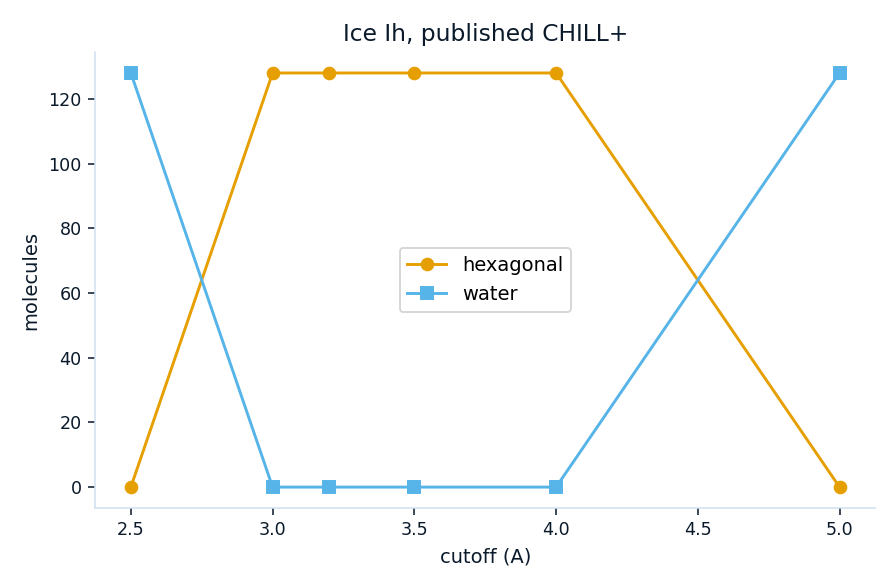
At 2.5 angstrom the shell is empty of the contact and every molecule is water. From 3.0 through 4.0 angstrom the cell is entirely hexagonal. At 5.0 angstrom the extra neighbours wash the label out and the cell is water again. 3.5 angstrom is the default the tutorials use.
A confined sheet and a nanotube use the same shell. If the first peak of g(r) moves, move the cutoff with it, and check that a known crystal of that phase still classifies cleanly.