Bulk ice and hydrate cages
Ice Ih is a stack of hexagonal cages. Ice Ic is a network of double-diamond cages. A clathrate hydrate is a different polyhedron: pentagonal dodecahedra, and larger cages whose faces are pentagons and hexagons. This tutorial asks the topological criterion for both.
The inputs are small and public.
examples/inputs/ice1h.lammpstrj: 128 oxygens of a 2x2x2 ice Ih cell.examples/inputs/ice_ic.lammpstrj: 64 oxygens on a 2x2x2 diamond lattice, cube edge 6.358 angstrom.examples/inputs/genice_sI.lammpstrj,genice_sII.lammpstrj,genice_sH.lammpstrj: one unit cell of each empty hydrate.
A molecule in a finished hexagonal cage (HC) is ice Ih. A molecule in a finished double-diamond cage (DDC) is ice Ic. Hydrate cages are named by their face census. 512 is twelve pentagons. 51262 is twelve pentagons and two hexagons. 51264 is the larger sII cage. sh and 51268 are the medium and large sH cages.
Run the blocks from the repository root.
# example
from pathlib import Path

from dseams.userframe import read

from examples.render import IC, IH, panel, save

inp = Path("examples/inputs")
fig = Path("docs/images/figures")

ih = read(inp / "ice1h.lammpstrj", atom_type=1)
ic = read(inp / "ice_ic.lammpstrj", atom_type=1)
assert ih.chill_plus()["hexagonal"] == 128
assert ih.cages().n_ih == 128 and ih.cages().n_ic == 0
assert ic.chill_plus()["cubic"] == 64
assert ic.cages().n_ih == 0 and ic.cages().n_ic == 64
print("Ih", ih.chill_plus(), ih.cages())
print("Ic", ic.chill_plus(), ic.cages())

census = {
    "sI 512": (2, 40),
    "sI 51262": (6, 46),
    "sII 512": (16, 136),
    "sII 51264": (8, 128),
    "sH 512": (12, 136),
    "sH sh": (8, 112),
    "sH 51268": (4, 120),
}
files = {
    "sI": inp / "genice_sI.lammpstrj",
    "sII": inp / "genice_sII.lammpstrj",
    "sH": inp / "genice_sH.lammpstrj",
}
frames = {name: read(path, atom_type=1) for name, path in files.items()}
measured = []
for label, (n_cages, n_atoms) in census.items():
    guest, spec = label.split()
    found = frames[guest].cages_by_signature(spec, edge="none")
    assert len(found) == n_cages
    assert found.n_atoms == n_atoms
    measured.append(len(found))
    print(label, len(found), found.n_atoms)

chart, ax = panel()
ax.bar(["Ih HC", "Ih DDC", "Ic HC", "Ic DDC"], [128, 0, 0, 64], color=[IH, IC, IH, IC])
ax.set_ylabel("molecules")
ax.set_title("Seeded cages")
save(chart, fig / "bulk-cages.png")

chart, ax = panel(7.2, 4.2)
ax.bar(list(census), measured, color="#0e4da4")
ax.set_ylabel("cages")
ax.set_title("Hydrate face census")
ax.tick_params(axis="x", rotation=30)
save(chart, fig / "hydrate-census.png")
# example
using Dseams

ih = read_frame("examples/inputs/ice1h.lammpstrj"; type=1)
ice = chill_plus(ih)
found = cages(ih)
@assert ice.counts["hexagonal"] == 128
@assert found.n_ih == 128 && found.n_ic == 0

ic = read_frame("examples/inputs/ice_ic.lammpstrj"; type=1)
cubic = chill_plus(ic)
ic_cages = cages(ic)
@assert cubic.counts["cubic"] == 64
@assert ic_cages.n_ic == 64 && ic_cages.n_ih == 0

si = read_frame("examples/inputs/genice_sI.lammpstrj"; type=1)
small = signature_cages(si, "512")
large = signature_cages(si, "51262")
@assert small.cages == 2 && small.atoms == 40
@assert large.cages == 6 && large.atoms == 46
println(ice.counts["hexagonal"], " ", ic_cages.n_ic, " ", small.cages, " ", large.cages)
// example
fn main() {
    let mut system = seams::System::new().expect("system");
    system
        .read("examples/inputs/ice1h.lammpstrj", 1, 1)
        .expect("read");
    let ice = system
        .chill_plus(&seams::ChillOptions::default())
        .expect("chill");
    let cages = system.cages(&seams::CageOptions::default()).expect("cages");
    let counts = cages.counts().expect("counts");
    assert_eq!(ice.counts[1], 128);
    assert_eq!(counts.hexagonal, 128);

    system
        .read("examples/inputs/ice_ic.lammpstrj", 1, 1)
        .expect("read");
    let ice = system
        .chill_plus(&seams::ChillOptions::default())
        .expect("chill");
    let cages = system.cages(&seams::CageOptions::default()).expect("cages");
    let counts = cages.counts().expect("counts");
    assert_eq!(ice.counts[0], 64);
    assert_eq!(counts.cubic, 64);

    system
        .read("examples/inputs/genice_sII.lammpstrj", 1, 1)
        .expect("read");
    let small = system
        .signature_cages(&seams::SignatureOptions {
            spec: "512".into(),
            ..Default::default()
        })
        .expect("512");
    let large = system
        .signature_cages(&seams::SignatureOptions {
            spec: "51264".into(),
            ..Default::default()
        })
        .expect("51264");
    assert_eq!((small.cages, small.atoms), (16, 136));
    assert_eq!((large.cages, large.atoms), (8, 128));
    println!("sII {} {}", small.cages, large.cages);
}
# example
set -euo pipefail
seams chill-plus examples/inputs/ice1h.lammpstrj --type 1 --cutoff 3.5 | tee /tmp/ih.txt
grep -q "hexagonal 128" /tmp/ih.txt
seams cages examples/inputs/ice1h.lammpstrj --type 1 --cutoff 3.5 | tee /tmp/ih-cages.txt
grep -q "hexagonal 128" /tmp/ih-cages.txt
seams chill-plus examples/inputs/ice_ic.lammpstrj --type 1 --cutoff 3.5 | tee /tmp/ic.txt
grep -q "cubic 64" /tmp/ic.txt
seams cages examples/inputs/genice_sI.lammpstrj --type 1 --graph cutoff --signature 512+51262 --cage-edge none | tee /tmp/si.txt
grep -q "signature 5:12 cages 2 atoms 40" /tmp/si.txt
grep -q "signature 5:12,6:2 cages 6 atoms 46" /tmp/si.txt
seams cages examples/inputs/genice_sII.lammpstrj --type 1 --graph cutoff --signature 512+51264 --cage-edge none | tee /tmp/sii.txt
grep -q "signature 5:12 cages 16 atoms 136" /tmp/sii.txt
grep -q "signature 5:12,6:4 cages 8 atoms 128" /tmp/sii.txt
seams cages examples/inputs/genice_sH.lammpstrj --type 1 --graph cutoff --signature 512+sh+51268 --cage-edge none | tee /tmp/sh.txt
grep -q "signature 5:12 cages 12 atoms 136" /tmp/sh.txt
grep -q "signature 4:3,5:6,6:3 cages 8 atoms 112" /tmp/sh.txt
grep -q "signature 5:12,6:8 cages 4 atoms 120" /tmp/sh.txt
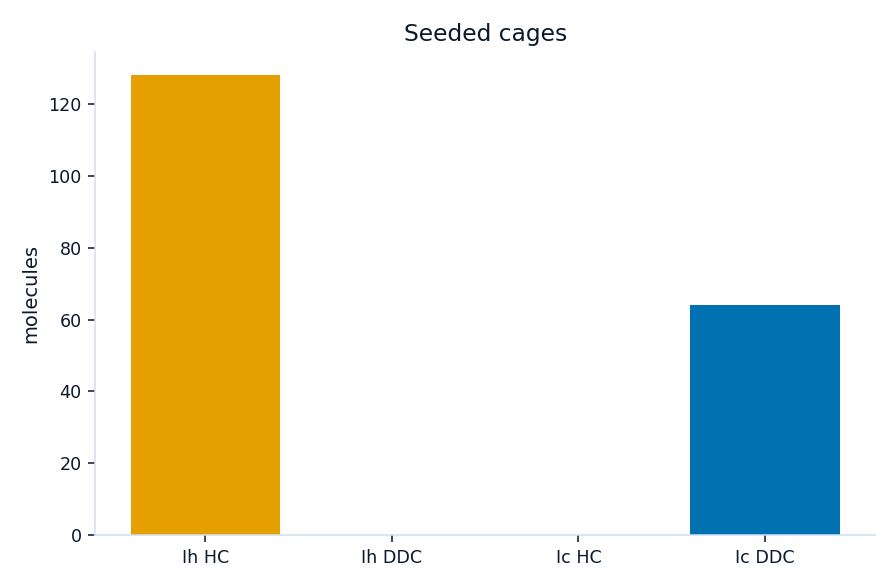
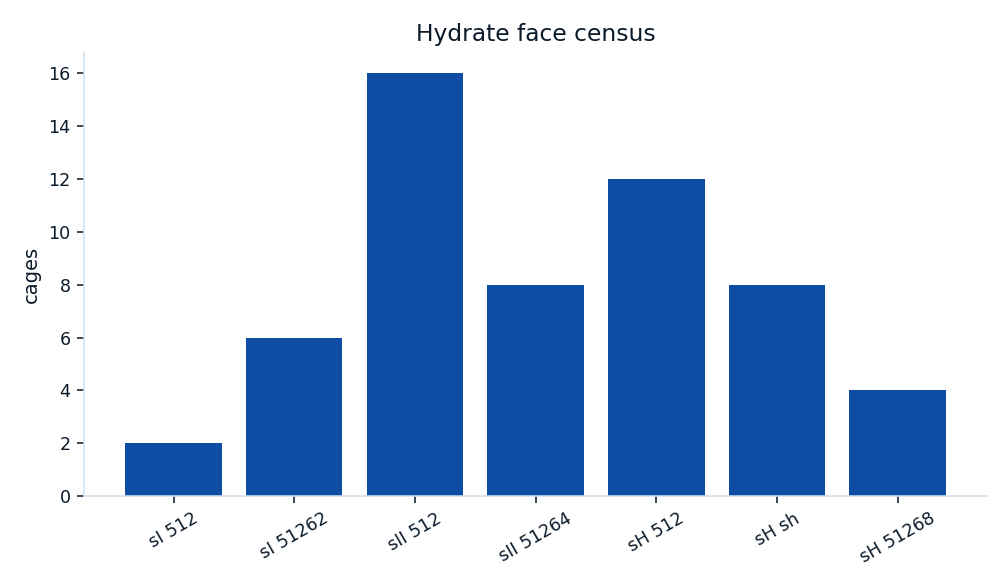
Ice Ih is entirely hexagonal, both by CHILL+ and by the cage score. Ice Ic is entirely cubic. One sII cell holds 16 dodecahedra and 8 hexakaidecahedra. The sH cell is triclinic. Its tilt is the subject of Triclinic cells.
The renders of these frames are in the gallery. The cage shapes are explained in Prisms and cages.