Ice/water interface
A basal interface is a slab of ice against a slab of liquid, in one frame. CHILL+ labels every oxygen. Binning those labels along the long axis shows where the crystal gives way to the liquid.
The frame is examples/inputs/interface_f0.lammpstrj: 864 oxygens in a box about 23 by 22 by 53 angstrom. The long edge is z.
# example
from pathlib import Path

import numpy as np
from dseams.userframe import read

from examples.render import IH, WATER, panel, save

frame = read("examples/inputs/interface_f0.lammpstrj", atom_type=1)
labels = frame.chill_plus()
assert labels["hexagonal"] == 352
assert labels["water"] == 434
assert labels["interfacial"] == 49
assert labels["cubic"] == 1
names = frame._labels
z = frame.positions[:, 2]
crystal = np.array([name == "hexagonal" for name in names])
edges = np.arange(z.min(), z.max() + 3.7, 3.7)
centres, fractions = [], []
for lo, hi in zip(edges[:-1], edges[1:]):
    mask = (z >= lo) & (z < hi)
    if mask.sum() == 0:
        continue
    centres.append(0.5 * (lo + hi))
    fractions.append(crystal[mask].mean())
# Slab centre where the hexagonal fraction falls through one half,
# after the crystal plateau.
front = next(c for c, frac in zip(centres, fractions) if c > 15.0 and frac < 0.5)
assert 22.0 < front < 26.0
print(labels)
print("front", round(front, 2))

chart, ax = panel()
ax.plot(centres, fractions, color=IH, marker="o")
ax.axhline(0.5, color=WATER, linewidth=1)
ax.set_xlabel("z (A)")
ax.set_ylabel("hexagonal fraction")
ax.set_title("Basal interface")
save(chart, Path("docs/images/figures/interface.png"))
# example
using Dseams

frame = read_frame("examples/inputs/interface_f0.lammpstrj"; type=1)
ice = chill_plus(frame)
@assert ice.counts["hexagonal"] == 352
@assert ice.counts["water"] == 434
@assert ice.counts["interfacial"] == 49
@assert ice.counts["cubic"] == 1
println(ice.counts["hexagonal"], " ", ice.counts["water"])
// example
fn main() {
    let mut system = seams::System::new().expect("system");
    system
        .read("examples/inputs/interface_f0.lammpstrj", 1, 1)
        .expect("read");
    let ice = system
        .chill_plus(&seams::ChillOptions::default())
        .expect("chill");
    assert_eq!(ice.counts[1], 352);
    assert_eq!(ice.counts[2], 434);
    assert_eq!(ice.counts[3], 49);
    assert_eq!(ice.counts[0], 1);
    println!("hexagonal {} water {}", ice.counts[1], ice.counts[2]);
}
# example
set -euo pipefail
seams chill-plus examples/inputs/interface_f0.lammpstrj --type 1 --cutoff 3.5 --layers --axis 2 | tee /tmp/interface.txt
grep -q "hexagonal 352" /tmp/interface.txt
grep -q "water 434" /tmp/interface.txt
grep -q "stack HHHHHHHH....C." /tmp/interface.txt
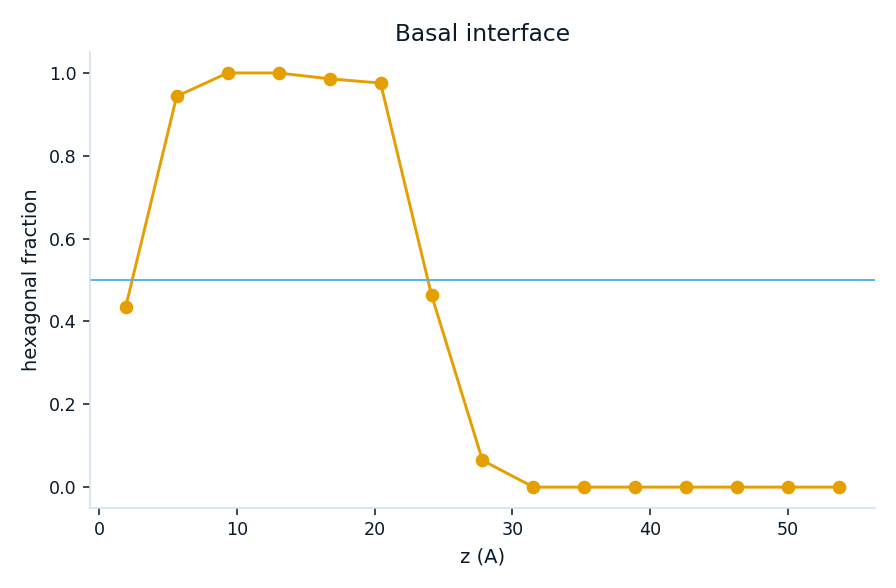
The published CHILL+ rule finds 352 hexagonal molecules, 434 waters, 49 interfacial molecules, and a single cubic molecule. --layers prints the basal stack HHHHHHHH....C.: eight hexagonal slabs, a gap, and one cubic layer. The hexagonal fraction along z stays near one through that slab and falls through one half in the next 3.7 angstrom bin. A coloured render is in the gallery.