Ions
An ion is not a vertex of the hydrogen-bond network. The cage assignment runs on the water. Each ion is then classed by the water in its first shell: ice when every neighbour in that shell is ice, liquid when none of it is, and front otherwise.
examples/inputs/nacl_front.lammpstrj is a basal ice slab with sodium and chloride. Water is type 1. The ions are types 3 and 4. The shell radius used here is 3.5 angstrom.
# example
from pathlib import Path

import pydseams as ds

from examples.render import IC, IH, WATER, panel, save

frame = ds.read("examples/inputs/nacl_front.lammpstrj", atom_type=1, all_atoms=True)
env = frame.ion_environment((3, 4), ring_adjacent=True, cutoff=3.5)
assert (env.nIce, env.nFront, env.nLiquid) == (1, 0, 8)
print(env.nIce, env.nFront, env.nLiquid)

chart, ax = panel()
ax.bar(["in ice", "front", "liquid"], [env.nIce, env.nFront, env.nLiquid], color=[IH, IC, WATER])
ax.set_ylabel("ions")
ax.set_title("First-shell class")
save(chart, Path("docs/images/figures/ions.png"))
# example
set -euo pipefail
seams ions examples/inputs/nacl_front.lammpstrj --type 1 --ion-types 3,4 --ion-cutoff 3.5 --complete | tee /tmp/ions.txt
grep -q "ions 9" /tmp/ions.txt
grep -q "in-ice 1" /tmp/ions.txt
grep -q "front 0" /tmp/ions.txt
grep -q "liquid 8" /tmp/ions.txt
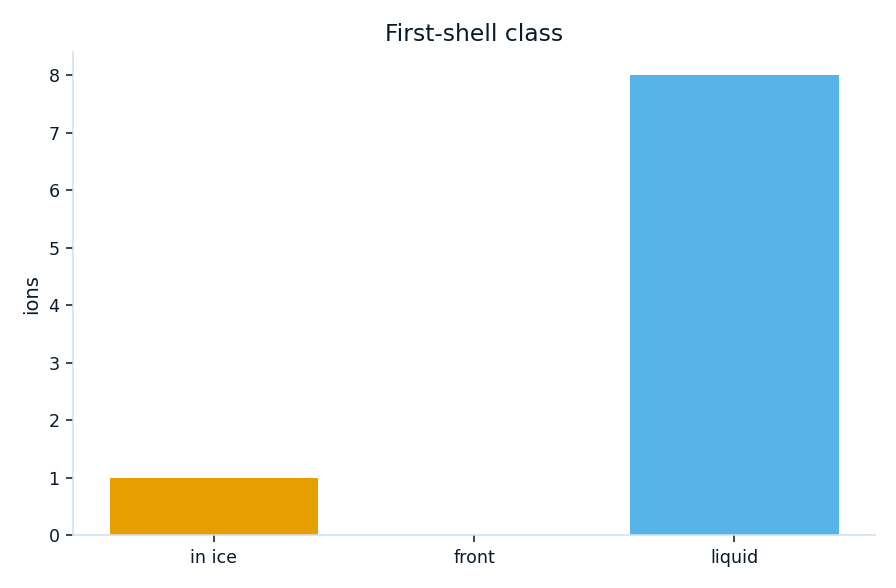
Nine ions sit in the frame. One is buried in ice. Eight see only liquid water. None sits on the front at this cutoff. seams cn --ions is a different command: it is a coordination number on an ion site table, and it needs --site.
The same split is what DSEAMS_CAGES reports as nionice, nionfront, and nionliq when you pass IONS. See On the fly with PLUMED.