Monolayer rings
A flat sheet of water is a two-dimensional network. The ice is the primitive rings that tile it. Square ice is a tiling by four-membered rings.
examples/inputs/monolayer.lammpstrj is an 8 by 8 square lattice, spacing 2.75 angstrom, 64 oxygens. Each site is shifted along z by 0.15 sin(i) angstrom so the sheet has a thickness. The cell in the plane is 22 angstrom on a side. Pass that area when you ask for coverage.
# example
import tempfile
from pathlib import Path

from dseams.userframe import read

from examples.render import panel, save

frame = read("examples/inputs/monolayer.lammpstrj", atom_type=1)
rings = frame.monolayer_rings(tempfile.mkdtemp(), sheet_area=22.0 * 22.0, max_depth=6)
assert rings[4]["count"] == 64
assert rings[4]["coverage_xy"] == 100.0
assert rings[3]["count"] == rings[5]["count"] == rings[6]["count"] == 0
print(rings)

chart, ax = panel()
sizes = [3, 4, 5, 6]
ax.bar([str(n) for n in sizes], [rings[n]["count"] for n in sizes], color="#0e4da4")
ax.set_xlabel("ring size")
ax.set_ylabel("rings")
ax.set_title("Square sheet")
save(chart, Path("docs/images/figures/monolayer-rings.png"))
# example
using Dseams

sys = System()
seams_system_read(sys, "examples/inputs/monolayer.lammpstrj", 1, 1)
counts = seams_monolayer(sys; max_depth=6, sheet_area=22.0 * 22.0)
@assert counts[5] == 64
println(counts)
// example
fn main() {
    let mut system = seams::System::new().expect("system");
    system
        .read("examples/inputs/monolayer.lammpstrj", 1, 1)
        .expect("read");
    let counts = system
        .monolayer(&seams::SheetOptions {
            sheet_area: 22.0 * 22.0,
            max_size: 6,
            ..Default::default()
        })
        .expect("sheet");
    assert_eq!(counts[4], 64);
    println!("four-rings {}", counts[4]);
}
# example
set -euo pipefail
seams rings examples/inputs/monolayer.lammpstrj --type 1 --cutoff 3.5 --max-ring 6 | tee /tmp/sheet.txt
grep -q "rings 64" /tmp/sheet.txt
grep -q "^4 64$" /tmp/sheet.txt
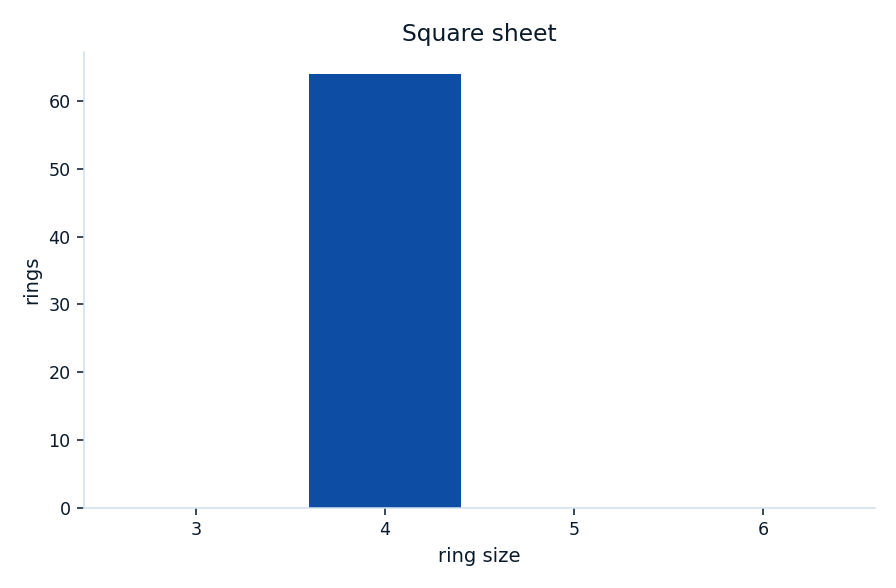
Every primitive ring is a square, and those squares cover the sheet. The in-plane pair histogram of this file is in Radial distributions. Primitive rings are explained in Primitive rings.