Nucleation
A nucleus is the largest cluster of ice-like molecules, and the thing you track is how that cluster changes from frame to frame. q6-bar of the whole frame moves only a little while the cluster is still small. The cluster size is the sharper coordinate.
examples/inputs/nucleation_three.lammpstrj holds three frames of 4096 sites. seams cluster is a different number: it is the largest connected piece of every loaded atom, which on this network is almost the whole box. The nucleus is the largest connected set of molecules that sit in a cage.
# example
from pathlib import Path

import numpy as np
import pydseams as ds
from dseams.userframe import read
from pydseams import Trajectory
from pydseams.features import IceFeaturizer

from examples.render import IC, IH, panel, save

path = "examples/inputs/nucleation_three.lammpstrj"
means = []
for number in (1, 2, 3):
    frame = read(path, frame=number, atom_type=1)
    bar = frame.steinhardt(6)["ql_bar"]
    means.append(sum(bar) / len(bar))
assert abs(means[0] - 0.26063) < 5e-5

traj = Trajectory(path, frame=1, atom_type=1, cutoff=3.5)
features, _states = IceFeaturizer(traj).transform()
names = IceFeaturizer(traj).feature_names
n_max = features[:, names.index("n_max")]
n_ice = features[:, names.index("n_ice")]
assert list(n_max) == [196.0, 208.0, 204.0]
print("q6bar", [round(v, 6) for v in means])
print("n_ice", n_ice.tolist())
print("n_max", n_max.tolist())

chart, ax = panel()
frames = np.arange(1, 4)
ax.plot(frames, n_max, color=IH, marker="o", label="largest cage cluster")
ax.plot(frames, n_ice, color=IC, marker="s", label="molecules in a cage")
ax.set_xlabel("frame")
ax.set_xticks(frames)
ax.set_ylabel("molecules")
ax.set_title("Three frames of a nucleation run")
ax.legend()
save(chart, Path("docs/images/figures/nucleation.png"))
# example
using Dseams

path = "examples/inputs/nucleation_three.lammpstrj"
means = Float64[]
for number in 1:3
    frame = read_frame(path; frame=number, type=1)
    order = q4_q6(frame)
    push!(means, sum(order.q6bar) / length(order.q6bar))
end
@assert abs(means[1] - 0.26063) < 5e-4
println(means)
// example
fn main() {
    let mut system = seams::System::new().expect("system");
    for frame in 1..=3 {
        system
            .read("examples/inputs/nucleation_three.lammpstrj", frame, 1)
            .expect("read");
        let summary = system
            .q6bar(&seams::Q6BarOptions::default())
            .expect("q6bar");
        println!("frame {frame} q6bar {}", summary.mean);
        if frame == 1 {
            assert!((summary.mean - 0.26063).abs() < 5e-5);
        }
    }
}
# example
set -euo pipefail
seams steinhardt examples/inputs/nucleation_three.lammpstrj --type 1 --frame 1 --last 3 --l 6 | tee /tmp/nuc-q.txt
grep -q "q6bar 0.26063" /tmp/nuc-q.txt
seams cages examples/inputs/nucleation_three.lammpstrj --type 1 --frame 1 --last 3 | tee /tmp/nuc-cages.txt
seams cluster examples/inputs/nucleation_three.lammpstrj --type 1 --frame 1 | tee /tmp/nuc-all.txt
grep -q "largest 4095" /tmp/nuc-all.txt
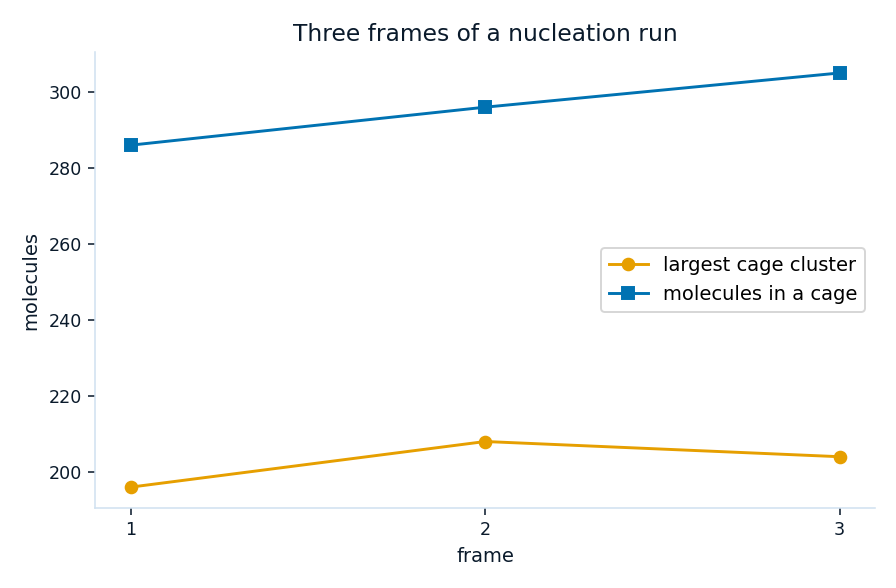
Mean q6-bar on the first frame is 0.26063. Across the three frames it barely moves. The largest cage cluster is 196, then 208, then 204 molecules. The largest component of every atom is 4095, which is the liquid network, not the nucleus.
Threading of this same file is in Large systems. The PLUMED action reports this cluster as nmax in On the fly with PLUMED.