CHILL+ and q6
Two numbers are often quoted for the same oxygen. CHILL+ is a label. It looks at the staggered and eclipsed bonds among the four nearest neighbours and calls the molecule cubic, hexagonal, interfacial, clathrate, interfacial clathrate, or water. q6 is a Steinhardt parameter: how directional the neighbour shell is. The Lechner-Dellago average, q6-bar, mixes that number with the neighbours' own q6.
They answer different questions. A crystal of ice Ih scores high on both. A disordered hydrogen-bond network scores as water under CHILL+ and sits at a lower q6.
The crystal is examples/inputs/ice1h.lammpstrj. The disordered frame is examples/inputs/exampleTraj.lammpstrj, 250 oxygens of type 2.
# example
from pathlib import Path

from dseams.userframe import read

from examples.render import IH, WATER, panel, save

crystal = read("examples/inputs/ice1h.lammpstrj", atom_type=1)
mixed = read("examples/inputs/exampleTraj.lammpstrj", atom_type=2)
labels = crystal.chill_plus()
other = mixed.chill_plus()
assert labels["hexagonal"] == 128
assert other["interClathrate"] == 9 and other["water"] == 241
q6 = crystal.steinhardt(6)["ql"]
q6_mixed = mixed.steinhardt(6)["ql"]
mean = sum(q6) / len(q6)
mean_mixed = sum(q6_mixed) / len(q6_mixed)
assert abs(mean - 0.625855) < 1e-4
assert mean_mixed < mean
print(labels, mean)
print(other, mean_mixed)

chart, ax = panel()
ax.hist(q6, bins=12, color=IH, alpha=0.85, label="ice Ih")
ax.hist(q6_mixed, bins=12, color=WATER, alpha=0.75, label="mixed frame")
ax.set_xlabel("q6")
ax.set_ylabel("molecules")
ax.set_title("CHILL+ crystal against a mixed frame")
ax.legend()
save(chart, Path("docs/images/figures/q6.png"))
# example
using Dseams

crystal = read_frame("examples/inputs/ice1h.lammpstrj"; type=1)
ice = chill_plus(crystal)
order = q4_q6(crystal)
mean = sum(order.q6) / length(order.q6)
@assert ice.counts["hexagonal"] == 128
@assert abs(mean - 0.625855) < 1e-4

mixed = read_frame("examples/inputs/exampleTraj.lammpstrj"; type=2)
other = chill_plus(mixed)
@assert other.counts["interClathrate"] == 9
@assert other.counts["water"] == 241
println(mean, " ", other.counts["water"])
// example
fn main() {
    let mut system = seams::System::new().expect("system");
    system
        .read("examples/inputs/ice1h.lammpstrj", 1, 1)
        .expect("read");
    let ice = system
        .chill_plus(&seams::ChillOptions::default())
        .expect("chill");
    let q6 = system.q4q6(3.5).expect("q6");
    let mean = q6.q6.iter().sum::<f64>() / q6.q6.len() as f64;
    assert_eq!(ice.counts[1], 128);
    assert!((mean - 0.625855).abs() < 1e-4);

    system
        .read("examples/inputs/exampleTraj.lammpstrj", 1, 2)
        .expect("read");
    let other = system
        .chill_plus(&seams::ChillOptions::default())
        .expect("chill");
    assert_eq!(other.counts[5], 9);
    assert_eq!(other.counts[2], 241);
    println!("q6 {mean} water {}", other.counts[2]);
}
# example
set -euo pipefail
seams chill-plus examples/inputs/ice1h.lammpstrj --type 1 --cutoff 3.5 | tee /tmp/chill-ih.txt
grep -q "hexagonal 128" /tmp/chill-ih.txt
seams steinhardt examples/inputs/ice1h.lammpstrj --type 1 --cutoff 3.5 --l 6 | tee /tmp/q6.txt
grep -q "q6 0.625855" /tmp/q6.txt
seams chill-plus examples/inputs/exampleTraj.lammpstrj --type 2 --cutoff 3.5 | tee /tmp/chill-mix.txt
grep -q "interClathrate 9" /tmp/chill-mix.txt
grep -q "water 241" /tmp/chill-mix.txt
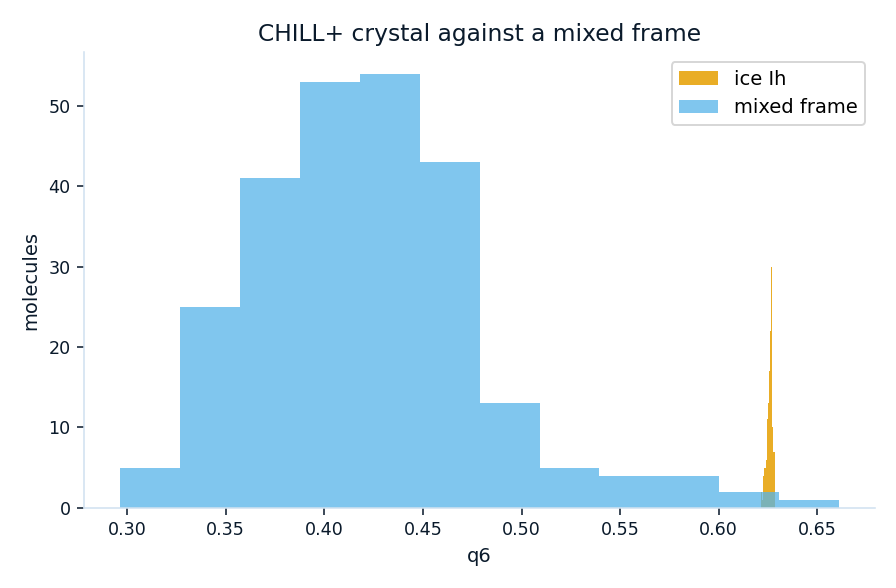
On the ice Ih cell every molecule is hexagonal and the mean q6 is 0.625855. On the mixed frame CHILL+ finds 9 interfacial-clathrate molecules and 241 waters, and the q6 distribution sits to the left of the crystal. How the two criteria relate is in Two ways to name ice. The neighbour cutoff that feeds both is in Choose a cutoff.