On the fly with PLUMED
DSEAMS_CAGES is a PLUMED action. On each step it builds the four-nearest-neighbour graphs, the primitive six-rings, and the seeded cage assignment, and it reports integer counts. The counts have no derivatives. A run prints them, and a committor uses one of them as a basin coordinate.
The book is plumed.dseams.info. The same counts, on the ice Ih cell, are what the blocks below compute.
On examples/inputs/ice1h.lammpstrj every oxygen is in a hexagonal cage and in one cluster, and CHILL+ calls every oxygen hexagonal. The action's names for those numbers are nice, nmax, nih, and chillice. nic is the double-diamond count, which is zero. There are 256 primitive six-rings, which the action reports as sixrings.
# example
from pathlib import Path

from dseams.userframe import read

from examples.render import IH, panel, save

frame = read("examples/inputs/ice1h.lammpstrj", atom_type=1)
cages = frame.cages()
labels = frame.chill_plus()
rings = frame.ring_census(max_size=6)
nice = cages.n_ih + cages.n_ic - cages.n_both
assert (nice, cages.n_ih, cages.n_ic) == (128, 128, 0)
assert labels["hexagonal"] == 128
assert rings[6] == 256

text = """\
LOAD FILE=./libdseams_plumed.so
ice: DSEAMS_CAGES ATOMS=1-128 CUTOFF=3.5 COMPLETE
PRINT ARG=ice.nice,ice.nmax,ice.nic,ice.nih,ice.chillice,ice.sixrings STRIDE=1 FILE=ICE
COMMITTOR ARG=ice.nmax STRIDE=1 BASIN_LL1=0 BASIN_UL1=20 BASIN_LL2=100 BASIN_UL2=100000
"""
path = Path("examples/output/ice_ih.dat")
path.parent.mkdir(parents=True, exist_ok=True)
path.write_text(text, encoding="utf-8")
written = path.read_text(encoding="utf-8")
for key in ("DSEAMS_CAGES", "PRINT", "COMMITTOR", "ice.nice", "ice.nmax", "ice.sixrings"):
    assert key in written
print("nice", nice, "sixrings", rings[6])

chart, ax = panel()
ax.bar(
    ["nice", "nih", "nic", "chillice", "sixrings"],
    [nice, cages.n_ih, cages.n_ic, labels["hexagonal"], rings[6]],
    color=IH,
)
ax.set_ylabel("count")
ax.set_title("What DSEAMS_CAGES reports on ice Ih")
save(chart, Path("docs/images/figures/plumed.png"))
# example
set -euo pipefail
seams cages examples/inputs/ice1h.lammpstrj --type 1 --cutoff 3.5 | tee /tmp/plumed-cages.txt
grep -q "hexagonal 128" /tmp/plumed-cages.txt
seams rings examples/inputs/ice1h.lammpstrj --type 1 --cutoff 3.5 --max-ring 6 | tee /tmp/plumed-rings.txt
grep -q "^6 256$" /tmp/plumed-rings.txt
seams chill-plus examples/inputs/ice1h.lammpstrj --type 1 --cutoff 3.5 | tee /tmp/plumed-chill.txt
grep -q "hexagonal 128" /tmp/plumed-chill.txt
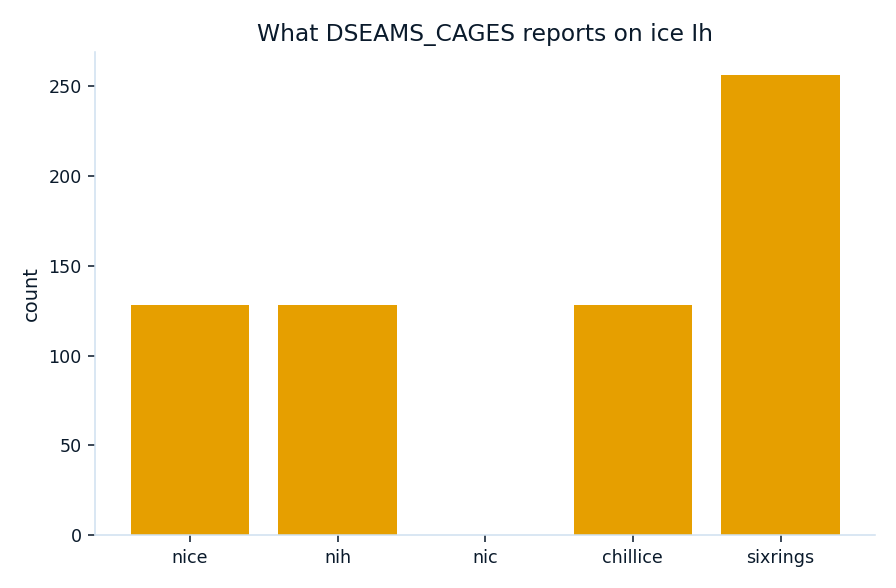
PRINT writes the arguments you name. COMMITTOR watches nmax, the largest connected cluster of cage molecules, and records which basin the trajectory is in. With IONS the same action adds nionice, nionfront, and nionliq, the split in Ions. SIGNATURE adds ncages for one face census, the split in Bulk ice and hydrate cages.
The cluster tracked over a nucleation trajectory is Nucleation.